The Nanoscale
Communication IC (NCIC) Labs is equipped with state-of-the art millimeter-wave
measurement facility. The acquisition of this facility was made possible by a
large research grant from the National Science Foundation under contract number:
CRI-0551735
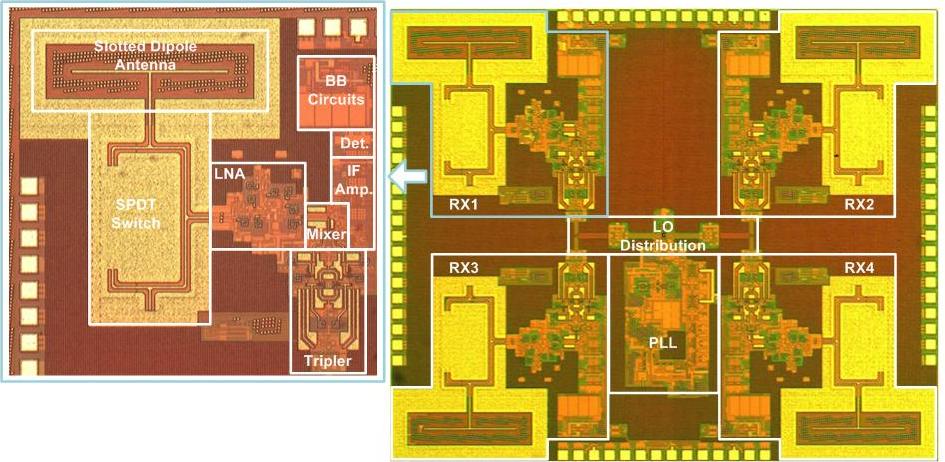
The vastly under-utilized spectrum in the THz frequency range enables disruptive applications including 10-gigabit chip-to-chip wireless communications and imaging/spectroscopy. On the imaging applications front, THz imaging is considered to be one of the emerging and disruptive technologies over the next decade [1]. As stated in that article: “great things are expected of terahertz waves in ranging from 0.3-3THz.” THz waves pass through non-conducting materials such as clothes, paper, wood and brick and so cameras sensitive to them can peer inside envelopes, into living rooms and "frisk" people at distance. THz imaging systems, therefore, will be key enabling components in applications such as security surveillance (to find concealed weapons and explosives), non-destructive testing, biology, radio astronomy, and medical imaging. On the sensing and communications, the absence of licensed frequency spectrum in the THz frequency range makes it possible to explore new unprecedented ideas on super-precise sensing at micrometer-level and multi-10-gigabit instant wireless access at the centimeter-level spacing between transmitter and receiver.
1. Zheng Wang, Pei-Yuan Chiang, Peyman Nazari, Chun-Cheng Wang, Zhiming Chen, and Payam Heydari, "A 210 GHz Fully Integrated Differential Transceiver with Fundamental Frequency VCO in 32 nm SOI CMOS," IEEE Int'l Solid-State Circuits Conference (ISSCC), Feb. 2013.
2. Pei-Yuan Chiang, Omeed Momeni, and Payam Heydari, "A Highly Efficient 0.2 THz Varactor-Less VCO with -7dBm Output Power in 130nm BiCMOS," IEEE Compound Semiconductor IC Symp. (CSICS), Oct. 2012.
3. Francis Caster, II, Leland Gilreath, Shiji Pan, Zheng Wang, Filippo Capolino, and Payam Heydari, "A 93-113GHz BiCMOS 9-Element Imaging Array Receiver Utilizing Spatial-Overlapping Pixels with Wideband Phase and Amplitude Control," IEEE Int'l Solid-State Circuits Conference (ISSCC), Feb. 2013.
(2) develop fully integrated passive/active imaging systems with on-chip antennas, while leveraging high level of integration offered by Silicon technologies.
Research and development of silicon-based solutions for millimeter-wave (MMW) applications has gained significant momentum in recent years. These applications include 60-GHz short-range high data-rate communications, automatic cruise control (ACC) and collision-avoidance systems using 24/77-GHz automotive radars, and more recently, 94-GHz/140-GHz security and medical applications using passive imaging. The goal of this research is to design fully integrated transceivers for automotive radars and imaging systems.

Die micrograph of the 3.9×1.9-mm2 dual-band 22-29-GHz/77-81-GHz BiCMOS Transceiver for Automotive Radars (ISSCC 2009 and JSSC Special Issue for ISSCC 2009)
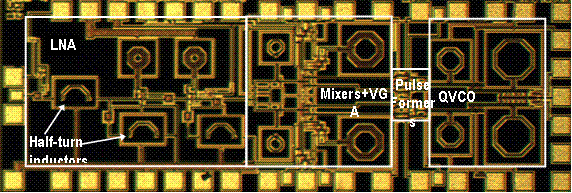
Die micrograph of a 22-29GHz UWB Pulse-Radar Receiver front-end measuring 3mm×1mm (CICC 2007 and T-MTT Aug. 2009)

An Ultra Wideband (UWB) Two-Stage Distributed CMOS Mixer
Selected publications:
1. Payam Heydari, "A Comprehensive Study of Low-Power Ultra Wideband Radio Transceiver Architectures," IEEE Wireless Communications & Networking Conference (WCNC), March 2005.
2. Amin Q. Safarian, Ahmad Yazdi, Payam Heydari, "Design and Analysis of an Ultra Wide-band Distributed CMOS Mixer,"
IEEE Trans. on VLSI Systems, no. 5, vol. 13, pp. 618-629, May 2005.3. Payam Heydari, Denis Lin, Amin Shameli, Ahmad Yazdi, "Design of CMOS Distributed Circuits for Multiband UWB Wireless Receivers," IEEE RF IC Symposium, 2005.
4. Payam Heydari and Denis Lin, "A Performance Optimized CMOS Distributed LNA for UWB Receivers," To appear in IEEE Custom Integrated Circuits Conference (CICC), Sept. 2005.
Various broadband wireline transmission standards have evolved for specific applications, including: (1) Optical Network (SONET) used in wide-area networks for long-haul (50-100km) transmission over fiber and (2) 10-Gigibit Ethernet, used for short- and medium-range communication over optical fiber, as well as short serial back-plane connections over copper. Although these protocols differ in higher-level data processing (e.g., framing), the requirements on the physical layer signal processing are similar for all of them. In particular, the system jitter and noise requirements in these broadband systems pose a number of challenges in the design of the electronic blocks. Operations such as equalization, serialization/deserialization, clock multiplication, and clock recovery are usually done electronically at the desired bit rates – 40Gb/s and higher up to 80Gb/s– require sufficiently accurate timing in the data transitions. Equally important is that the design of front-end high-speed circuits, including the transimpedance amplifier (TIA), laser driver, and channel equalizer, requires a comprehensive knowledge of the channel behavior. In the case of optical transceivers, the research efforts must build a bridge between the optical communications and advanced high-speed IC design.
|
A Novel Three-Stage Differential Non-Uniform Downsized Distributed Amplifier
Selected publications:
1. Ahmad Yazdi, Denis Lin, Payam Heydari, "A 1.8V Three-Stage 25GHz 3dB-BW Differential Non-Uniform Downsized Distributed Amplifier," IEEE International Solid-State Circuits Conference (ISSCC), Feb. 2005.2. Ravindran Mohanavelu and Payam Heydari, "A Novel Flip-Flop-Based Frequency Divider in 0.18mm CMOS," To appear in IEEE European Solid-State Circuits Conference (ESSCIRC), Sept. 2005.
Past Research
Noise and Signal Integrity in High-Speed Mixed-Signal VLSI Circuits
Noise is a crucial problem in modern mixed-signal VLSI circuits and is becoming increasingly important as the minimum feature size shrinks to 0.13 micron and below. Noise sources are either internal to the devices (e.g., shot noise, 1/f noise, and thermal noise), or external sources (e.g. bounce noise, crosstalk noise, and charge sharing noise). Due to their higher magnitude and energy, the external noise sources play a more important role in determining the circuit reliability and performance.
Power/ground noise,
crosstalk, and substrate noise are
major external noise sources that can have harmful effects on the circuit
performance and reliability. For example, they can cause false switching in the
logic gates especially dynamic logic gates, timing failures due to setup and
hold time violations, and timing jitter in the on-chip clock generators. The
goal of this research is to analysis power/ground noise, crosstalk, and
substrate noise in mixed-signal VLSI
circuits. We further focus on the effect of power/ground noise and substrate
noise on the timing
jitter of CMOS phase-locked loops (PLLs) and delay-locked-loops (DLLs).
Selected publications:
1. Payam Heydari, "Analysis
of the PLL Jitter Due to Power/Ground and Substrate Noise," IEEE Trans. on Circuits and Systems I,
no. 12, vol. 51, pp. 2404-2416, Dec. 2005. (Recipient of IEEE Circuits
and Systems Society Darlington Best Paper Award)
2. Payam Heydari, "Characterizing the Effects of the PLL Jitter Due to Substrate Noise in Discrete-Time Delta-Sigma Modulators," IEEE Trans. on Circuits and Systems I, 2005.
